Proving Compliance with Confidence: Traceability and Accountability in Data Privacy
Ensure privacy compliance with traceability. icaria DP logs every action, enabling full visibility, auditability, and accountability.

Why evidence matters
Global privacy frameworks — from GDPR in Europe to CCPA/CPRA in California, LGPD in Brazil, HIPAA in U.S. healthcare, and the upcoming Chilean data protection law — are built not only on compliance but also on accountability.
It is no longer enough for organizations to claim they respect subject rights. Regulators, auditors, and customers demand proof: evidence that requests have been properly executed, that actions are consistent across systems, and that compliance processes are continuously effective.
Without reliable traceability, organizations risk fines, reputational damage, and erosion of customer trust — even if they actually executed the request.
And these obligations cover any type of data subject: former customers, past or current employees, suppliers, intermediaries, or third parties. Each introduces unique applications and datasets that must all be included in a traceable and auditable process
The problem with manual tracking
In organizations that rely on manual or semi-automated processes, subject rights requests leave behind incomplete and fragmented records:
- A request may be logged in a workflow tool, but its execution is carried out manually in different systems.
- Evidence may be scattered across emails, spreadsheets, or siloed departmental tools.
- Reporting often depends on ad hoc reconciliation, leaving gaps and inconsistencies.
This creates systemic weaknesses:
- Audit gaps – Difficult to prove full compliance if documentation is incomplete.
- Lack of insight – No reliable metrics on efficiency or bottlenecks.
- Inconsistency – Different teams may apply different procedures.
The SRR workflow in context
According to Gartner, subject rights request (SRR) fulfillment must follow a repeatable and scalable seven-stage workflow: capture, logging, identity verification, triage, data collection, validation, and communication.
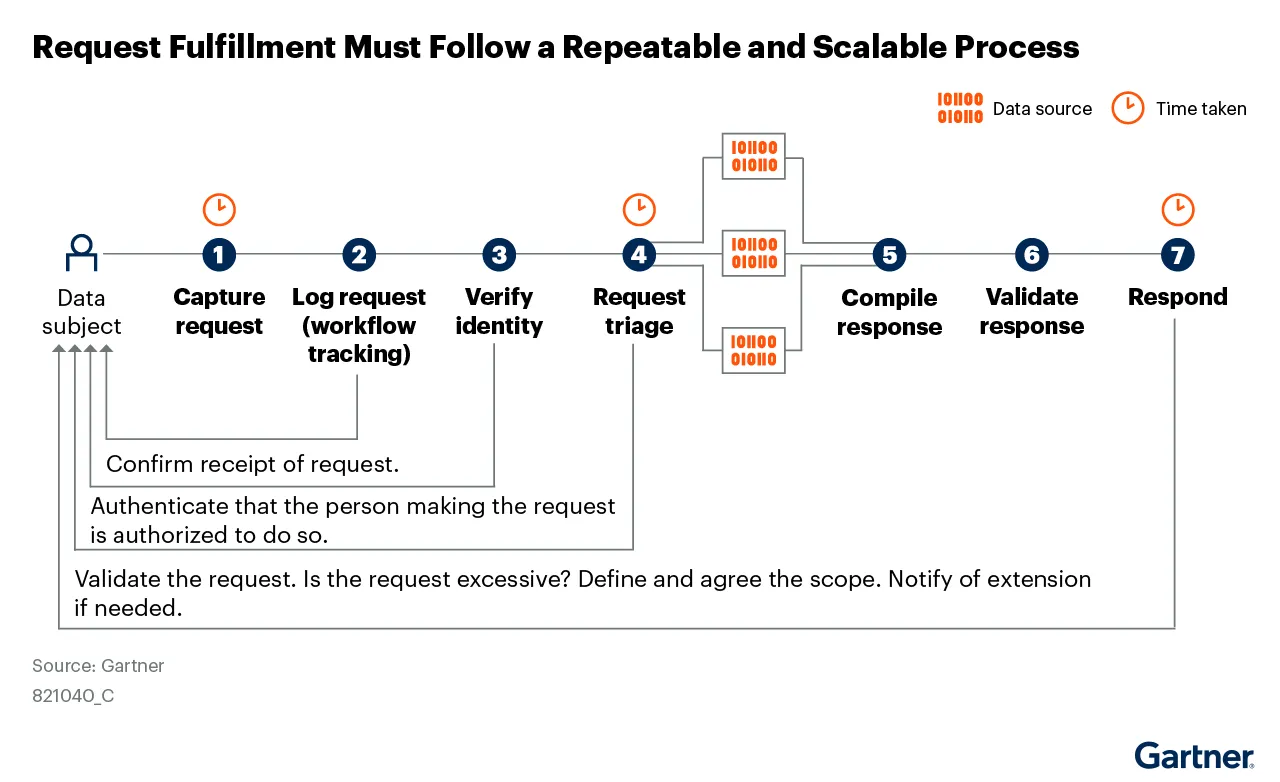
Source: Gartner, Best Practices for Automating Subject Rights Requests, 2024
Many privacy platforms provide strong capabilities in the early stages of this process — for example, portals to capture requests, identity verification, or workflow coordination. These are essential for delivering a good user experience.
icaria Data Privacy complements these platforms by focusing on the execution layer, while also identifying the data subjects to whom rights must be applied proactively. For instance, under GDPR, organizations must erase data of former customers, employees, or suppliers once retention periods expire, even without receiving a request. icaria ensures that such rights are automatically enforced at scale across all business systems, with every action logged and auditable.
How icaria Data Privacy ensures full traceability
icaria Data Privacy provides end-to-end visibility and accountability by recording every action taken in response to a subject rights request, across all applications and systems.
Core capabilities:
- Detailed audit logs – Every identification, blocking, rectification, erasure, or restoration is logged with timestamps, system details, and user identifiers.
- Workflow visibility – Organizations can track each request in real time, from intake to completion, across multiple applications.
- Compliance reporting – Prebuilt reports for regulators, auditors, and internal governance show exactly how requests were executed.
- Effectiveness measurement – Logs and dashboards highlight performance metrics (time to completion, volume of requests handled, error rates), enabling continuous improvement.
- Consistency across rights – Whether access, rectification, deletion, or restriction, icaria applies the same traceable process throughout the lifecycle.
- Support for critical SRR metrics (Time, Cost, Scale) – icaria’s automation reduces the time required to complete requests, lowers the cost of processing by removing manual reconciliation, and provides scalability to manage growing volumes of requests without sacrificing traceability.
Real-World example: Ibercaja group
The Ibercaja Group implemented icaria Data Privacy to manage data blocking and erasure processes across its parent bank and five subsidiaries. Although all belonged to the same financial group, each entity had its own application landscape and legal obligations.
Before adoption, coordinating subject rights execution and auditability across six separate organizations was complex and exposed the group to compliance risks. The main challenge was to ensure traceability and auditability of the right to erasure across all these entities. Coordinating evidence and standardized execution manually would have been unmanageable and exposed the group to compliance risks
With icaria Data Privacy, Ibercaja was able to:
- Automate the right to erasure at scale, applying it consistently across heterogeneous applications in all six organizations.
- Standardize processes for historical data sets and recurring monthly workloads, even in legacy and hybrid environments.
- Centralize traceability, generating unified audit trails that cover each subsidiary and can be shown instantly to auditors.
As Javier Martínez Lafuente, Director of Management Oversight at Ibercaja Financial Group, explains:
“The implementation of icaria Data Privacy to manage data blocking and erasure processes across the Ibercaja Group’s subsidiaries has enabled us to handle both historical data sets and recurring monthly processes across various legal entities — each supported by different informational and application environments — in a consistent and standardized way. This ensures the proper enforcement of our customers’ right to erasure.”
Complementing other approaches
Many organizations already use privacy platforms that excel at request intake, consent management, and workflow coordination. These solutions are highly effective at managing the visible side of compliance — collecting requests, verifying identities, tracking SLAs, and orchestrating approvals.
icaria Data Privacy is designed to extend and complement these capabilities by taking over the back-end execution layer. It ensures that the actions logged in front-end platforms — such as rectification, blocking, or erasure — are carried out consistently across all business systems, with full audit trails and compliance reporting.
This combined approach creates an end-to-end compliance architecture: front-end solutions handle request management, while icaria guarantees that every action is executed and traceable across the organization’s ecosystem.
Together, front-end platforms and icaria create a repeatable and scalable SRR process, where intake and user experience are seamlessly connected to reliable backend execution
Benefits of demonstrable compliance
Organizations gain tangible advantages by making traceability a core capability:
- Transparency – Regulators, auditors, and customers can see verifiable records of every action.
- Confidence – Demonstrable compliance reduces the risk of fines and reputational damage.
- Efficiency – Automated reporting and dashboards replace manual reconciliation.
- Continuous improvement – Metrics allow teams to refine processes and allocate resources effectively.
- Improved user experience – Faster and more consistent execution indirectly benefits individuals (customers, employees, or partners), who receive timely and verifiable responses.
- Scalable automation – icaria enables organizations to demonstrate that rights are enforced automatically and at scale, across thousands of individuals and heterogeneous applications, with complete traceability.
Conclusion
Traceability and accountability are not optional extras — they are regulatory necessities. From Europe to the Americas, privacy frameworks increasingly emphasize the ability to demonstrate compliance, not just achieve it.
icaria Data Privacy equips organizations with audit-grade traceability and workflow visibility, ensuring that every request is handled consistently, every action is documented, and every report is ready when regulators or auditors demand it.
By transforming accountability into a streamlined, automated process, icaria not only supports compliance but also strengthens transparency, operational trust, and long-term customer confidence.
Also, icaria supports all types of data subjects, aligns with critical performance metrics (time, cost, scale), and complements request intake platforms — identifying affected individuals and executing their rights across all systems, with audit-grade traceability for regulators and auditors.