Gartner Hype Cycle for Privacy, 2026: from managing policies to acting on data
Discover Gartner’s perspective on Data Discovery, Privacy Management, rights management, and data control in the Hype Cycle™ for Privacy, 2026.
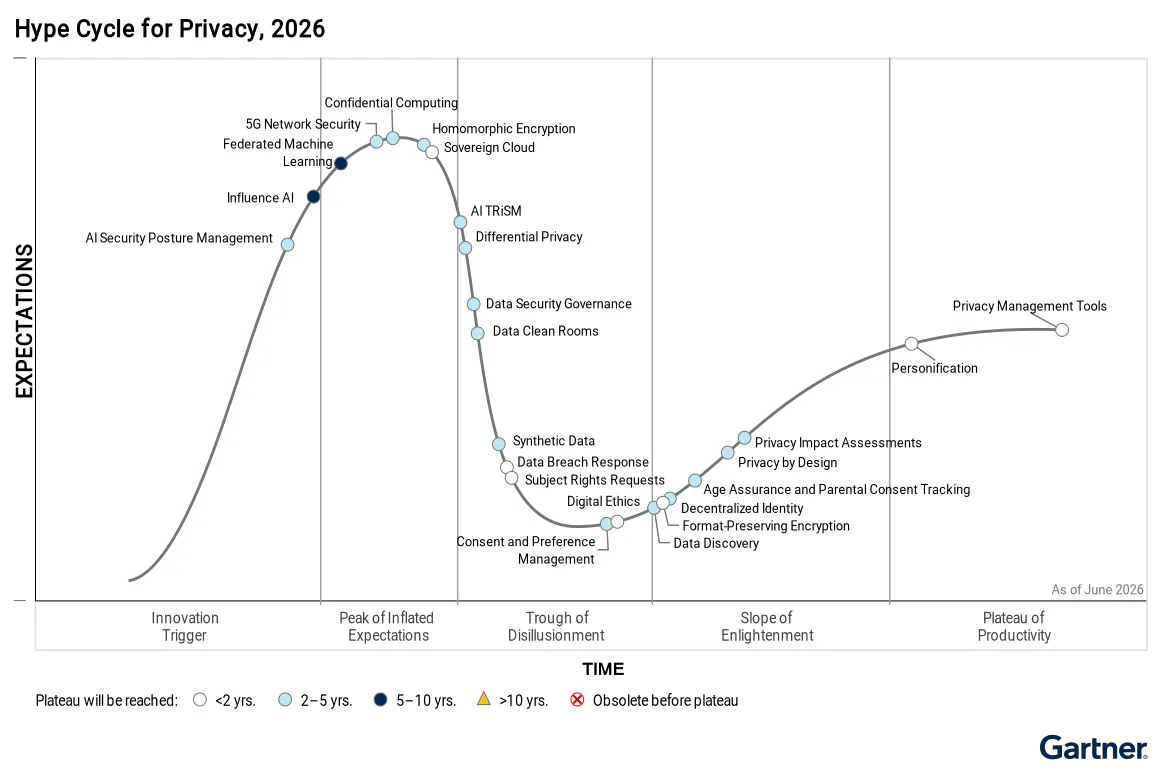
The Gartner® Hype Cycle™ for Privacy, 2026 analyzes the technologies and capabilities evolving to address an environment in which privacy management is becoming increasingly complex.
The expansion of artificial intelligence, growing data volumes, and evolving regulation are putting greater pressure on organizations. But the challenge is not limited to defining new policies or interpreting new obligations.
It also lies in being able to apply those policies to personal data that may be distributed across databases, applications, cloud services, SaaS platforms, and legacy systems.
The report covers technologies related to areas such as Data Discovery, Privacy Management Tools, Subject Rights Requests, and Privacy by Design, among others. Although they address different needs, many of them point to the same challenge: reducing the gap between privacy management and the systems where information actually resides.
In fact, one of the key ideas in the report is that neither technology nor policies alone are enough to build a mature privacy program. Organizations need to combine governance, processes, and policies with capabilities that enable them to understand and act on the data itself.
What does this shift mean, and why is knowledge of data becoming so important? We explore this below.
The Hype Cycle reflects an increasingly technological and operational approach to privacy
For a long time, much of the work around privacy has focused on defining policies, managing risks, documenting processing activities, and establishing procedures.
However, increasing technological complexity introduces an additional challenge: a policy can only be executed effectively if the organization knows which data it needs to act on.
For example, a retention policy may establish that certain information must be deleted after a specific period. But applying that policy requires knowing which information is affected, which applications contain it, and whether copies exist in other systems.
The same applies to minimization, the protection of sensitive data, or a deletion request.
In all these cases, the policy ultimately reaches the same point: the data.
This is why Gartner highlights the need to combine two complementary types of capabilities: privacy management and data-centric controls.
Data Discovery: knowing which data you need to act on
Among the capabilities analyzed by Gartner is Data Discovery.
Its relevance stems from a very specific problem: personal information is rarely concentrated in a single repository.
An organization may store data relating to the same individual across a CRM, internal applications, operational databases, SaaS platforms, legacy systems, or copies used by other processes.
Over time, this distribution makes it increasingly difficult to maintain a reliable view of the data.
Gartner notes that Data Discovery can help address this fragmentation across hybrid, cloud, and SaaS environments by providing visibility into distributed information. However, discovering data should not become an end in itself.
Its value comes from helping organizations answer privacy-related questions such as:
- What personal and sensitive information do we hold?
- Which systems contain it?
- Where are related data or copies located?
- Which information requires protection?
- Which data may be affected by a specific policy?
- Can we keep this knowledge up to date without having to rebuild it manually?
Answering these questions makes it possible to turn discovery into a map of personal and sensitive data.
The data map as the foundation of a privacy strategy
Having a data map creates a shared layer of knowledge that can support different processes.
For example, if an organization knows where a specific category of information is located and which systems use it, that knowledge can inform decisions related to:
- Minimization: identifying information that is no longer necessary.
- Retention: linking data to the retention periods established by internal policies.
- Deletion: locating the systems that contain the information on which an action needs to be performed.
- Protection: identifying personal or sensitive data that requires specific controls.
- Rights management: identifying information associated with an individual when they request access, rectification, or deletion.
The value of the data map, therefore, lies in its role as the starting point for taking action on data.
From discovering information to managing its lifecycle
The Hype Cycle itself establishes a connection between the insights generated through discovery and subsequent actions such as retention, deletion, or minimization.
An organization may fully understand what its retention policy requires. But if implementing it means manually requesting information from different departments, reviewing multiple applications, and checking where copies of the data remain, the process is unlikely to scale effectively.
The goal should be for the knowledge generated through discovery to inform subsequent decisions throughout the information lifecycle.
This enables organizations to move from: “We have a privacy policy in place” to: “We know which data is affected and can apply that policy to it.”
This is one of the most important shifts when privacy is approached from a data-centric perspective.
Privacy rights: when policies need to reach every system
Rights requests illustrate this challenge particularly clearly.
When an individual asks to access, rectify, or delete their personal data, receiving and registering the request is only one part of the process.
The information then needs to be located.
If the data is distributed across multiple systems, different searches and actions may be required from IT, Legal, or privacy teams.
For example, in response to a deletion request, the organization may need to:
- identify all data associated with the individual;
- determine where that information is located;
- distinguish between information that can be deleted and information that must be retained;
- carry out the necessary actions in each system;
- maintain evidence of what was done.
When all these tasks are performed manually, increasing data volumes or a growing number of requests can quickly increase the operational workload.
This is why technologies related to Subject Rights Requests and other automation capabilities are also part of the evolution reflected in the Hype Cycle.
Automation needs to reach the data itself
Privacy automation should not be limited to forms, workflows, or approval processes.
There is also an opportunity to automate part of the technical work required to execute privacy policies. For example:
- discovering personal information;
- classifying it;
- locating it across different data sources;
- identifying the systems affected by a particular action;
- executing specific processes on the data;
- maintaining traceability of the actions performed.
This becomes particularly relevant when privacy needs to be managed across organizations with a large number of applications or technology infrastructures that have evolved over many years.
The objective, therefore, is to enable decisions made by Privacy, Security, Legal, or IT teams to be executed more consistently and with less reliance on manual operations.
A challenge that grows with regulation and AI
This issue becomes even more relevant in sectors that process large volumes of personal data and operate under strict regulatory requirements.
Banking, insurance, telecommunications, healthcare, and large service organizations commonly operate within complex technology ecosystems and manage significant volumes of distributed information.
At the same time, regulations such as the GDPR, Spain’s LOPD, and Chile’s Law 21,719 are leading many organizations to review how they translate privacy obligations into technical and operational processes.
As more processes and use cases depend on data, it becomes increasingly important to understand what information exists, which data is sensitive, where it is stored, and under what criteria it can be used.
Privacy therefore increasingly depends on a capability that is also fundamental to data governance: maintaining knowledge and control over information.
How icaria Data Privacy helps connect policies with data
This is precisely one of the areas addressed by icaria Data Privacy.
The solution helps organizations identify, classify, and locate personal and sensitive information distributed across different systems.
This visibility creates a foundation for developing subsequent privacy and data protection processes.
These include:
- maintaining a map of personal and sensitive information;
- reducing reliance on manual data searches;
- connecting knowledge of the data with protection and lifecycle policies;
- making it easier to locate the information required to manage privacy rights;
- improving traceability of the actions performed.
The objective is to help reduce the gap between the privacy policy that defines what needs to be done and the systems where that decision needs to be executed.
icaria Data Privacy, mentioned as a Sample Vendor in the Hype Cycle for Privacy, 2026
In this edition of the Gartner® Hype Cycle™ for Privacy, 2026, icaria Data Privacy is mentioned as a Sample Vendor.
The inclusion of icaria Data Privacy comes within a report that reflects several of the challenges the solution addresses: discovery, knowledge of data, information protection, and the ability to extend privacy processes to the systems where data resides.
The Hype Cycle for Privacy, 2026 presents an ecosystem of technologies at different stages of maturity and designed to address different needs. But behind many of them lies a common dependency: to protect, minimize, delete, or manage the rights associated with data, organizations first need to know that the data exists and where it is located.
Data Discovery provides that starting point.
The next challenge is turning this knowledge into an operational capability: connecting discovery insights with privacy policies and ensuring that decisions reach the systems affected.
This is where privacy can evolve from an approach based primarily on processes and policies toward a model with greater control, traceability, and the ability to take action directly on data.
Want to discover the technologies and capabilities shaping this evolution? Download the Gartner® Hype Cycle™ for Privacy, 2026 and explore the full analysis.