Enterprise Data Governance

A unified view of data for effective governance

icaria Data Governance documents the data model of your applications and keeps it up to date, so you know what data you have, where it lives and how it relates.

The problem

Enterprise data is spread across many applications

In a large organisation, the same customer, contract or product can be represented in many systems, each with its own structure and its own copy of the data. Understanding those relationships is key to migrations, new developments, privacy processes and data quality and governance initiatives.

Different applications · different structures · shared business concepts

How it works

From the applications' metamodel to control of the data

icaria Data Governance synchronises the structures of your applications, records their changes, classifies their fields and assesses data quality and integrity across systems.

  1. Synchronise

    Reads the metamodel directly from the applications and records tables, fields, relationships, keys and indexes.

  2. Detect changes

    Compares each synchronisation with the reference and across production, test and development environments.

  3. Classify and assess

    Organises the fields of interest, identifies sensitive data and measures quality by field and by concept.

  4. Compare

    Checks whether different applications hold consistent values for the same business concept.

Govern data from the structure of your applications

Data discovery

Identify and document the structure of your applications

Development is ahead of production: the difference is what is still to be promoted.

icaria Data Governance registers each application with its environments and submodels and synchronises its metamodel directly from the database.

  • Capture tables, fields, relationships, indexes, keys and triggers.
  • Register the same application in production, test and development.
  • Link business terms to the applications where they appear and to their master application.

Metamodel management

Control how the metamodel evolves across environments

A change between environments is promoted or corrected before it reaches production.

The first synchronisation is kept as the reference snapshot. From there, icaria Data Governance compares later changes and checks the instances of an application against each other across environments.

  • Identify tables and fields that were added, modified or removed.
  • Detect drift between production, test and development.
  • Control how changes are promoted from one environment to another.

Data maps

Classify and organise the data that matters

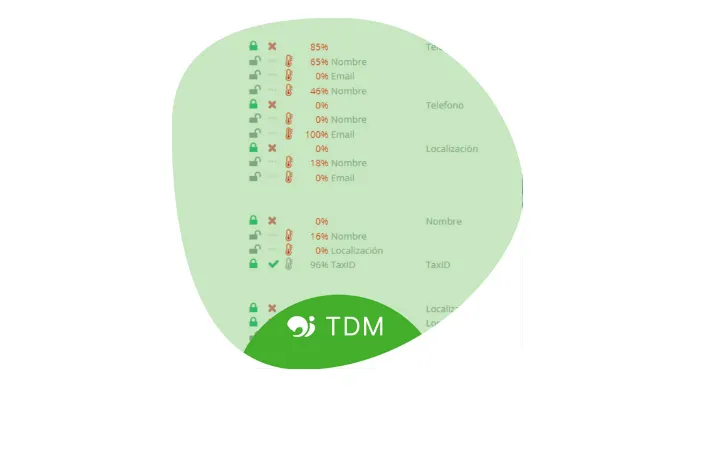
Pending: the security or testing approval is still missing.

icaria Data Governance gathers the fields of interest of each application in data maps, with their format, master location and approval status.

  • Classify identity documents, names, addresses, accounts, cards or IP addresses.
  • Apply inspectors to recognise each type of data.
  • Bring in the approval of security, development and testing.

Data quality · Information roles

Assess quality by field and by business concept

A role groups the fields that hold the same concept in each application.

icaria Data Governance validates each field and groups into information roles the fields that represent the same business concept in different tables or applications.

  • Get the total, valid, invalid, empty and null records of each field.
  • Group, for example, every field that represents “customer email”.
  • Check whether those fields hold the same value for the same entity.

Cross-application integrity

Validate data consistency across applications

Before the comparison, each value is normalised to the reference metamodel.

When different applications hold the same concept in different structures, icaria Data Governance transforms each value to a reference metamodel and applies comparison rules.

  • Define a common reference for each business concept.
  • Normalise formats before comparing values.
  • Publish the differences as integrity defects for follow-up.

A common view for the teams that work with data

  • Data office

    More visibility

    Start from an inventory built from the applications themselves and connect the glossary, the models and the integrity defects.

  • Data architecture

    More control

    Detect model changes, control promotion between environments and define common references to compare applications.

  • Privacy and quality

    More confidence

    Locate personal data and measure quality by field and by business concept.

Adoption and evolution

Start with what you need. Scale when you need to.

Adopt the platform at your own pace, speed up its rollout and adapt it to your processes without blocking its evolution.

  1. Progressive licensing

    A clear, scalable pricing model. Licences by capability and size, so investment matches the scope and volume you need at each stage.

  2. AI-assisted implementation

    Less effort to get started. icaria uses AI to speed up the initial analysis of metamodels and part of the configuration, shortening the path to stable operation.

  3. Extensible by design

    Extend the platform beyond its standard capabilities. Its low-code engine lets you add specific logic, integrations and processes while keeping the core separate and compatible with future versions.

Built for complex environments

  • Multi-technology

    Supports SQL and NoSQL databases, enterprise applications through native integrations, and other systems through a REST API.

  • Governed metamodel

    Records and keeps up to date data structures, their relationships and sensitive fields, to support governance across the lifecycle.

  • Collaborative control

    Define access by role and responsibility, log configuration changes, publish controlled versions and organise work with tags.

  • Secure deployment

    On-premise, cloud or hybrid, with LDAP/SSO, role-based permissions and privacy by design.

Turn your knowledge of the data into a governance capability

Find out how icaria Data Governance helps you document, control and validate the data spread across your applications.

Related content

Go deeper into Data Governance